
Latest update: August 2026
Find all functions f:\mathbb{Z}^+\rightarrow \mathbb{Z}^+ , where \mathbb{Z}^+ is the set of all positive integers, such that for any positive integers m,n, f^{f(m)}(n)+n=f^m(n)+f(n).
Made in: December 2024
Personal niceness rating: 6/10
Created forwards
I sat down one day and decided I wanted to make an iterative FE with both f(n)=n and f(n)=n+1 as solutions. This was either the first or second equation that I wrote down, and I found it satisfactory with the chain solution.
Relatively uninspiring motivation but usually that’s the case with FEs. I think it’s quite an instructive iterative problem though, and SMO Senior was probably the right place to put it.
Let a_1,a_2,\dots be an infinite sequence of positive integers. Let b_1,b_2,\dots and c_1,c_2,\dots be two sequences of non-negative integers. Suppose for any positive integer n, there exists positive integers i and m for which n=a_im^2+b_im+c_i.Prove that the sequence S_k=\frac{1}{a_1}+\frac{1}{a_2}+\dots+\frac{1}{a_k} is unbounded.
Made in: January 2026
Personal niceness rating: 6/10
Created forwards
A friend had an idea of a polynomial calculator question, where you can replace x with P_i(x). The question posed was – when can your calculator reach every positive integer from 1?
This turned out to be a hard question, so I restricted myself to quadratics P_i(x)=a_ix^2+b_ix+c_i. Obviously, if we can let P_i(1)=i, then the problem is trivial. However, this would require a_i\le i. Algebra intuition told me that the infinite sum \frac{1}{a_1}+\frac{1}{a_2}+\dots would probably be important, and as it turns out that was right.
Using complicated methods, I was able to prove that the sum of reciprocals is unbounded. A testsolver later found a cute one-line solution to the problem.
Find all infinite sequences of non-negative integers a_1,a_2,a_3,\dots such that every positive integer r has a unique representation r=a_m+a_{n+1}+mnwhere m,n are positive integers.
Made in: May 2026
Personal niceness rating: 8/10
Created backwards
The motivation for this statement was the following article by Zachary Abel:
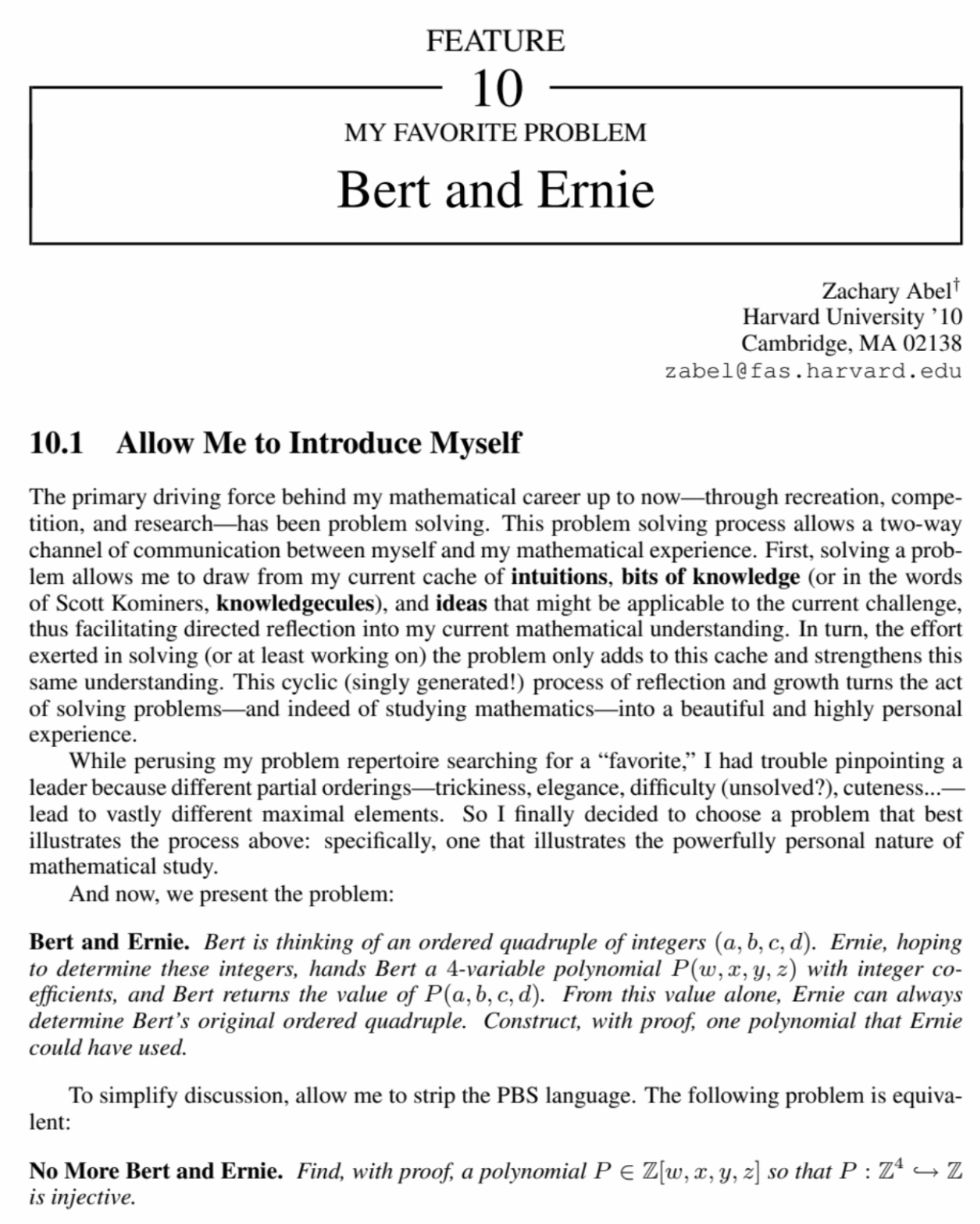
Importantly, he gives the formula for a bijection between \mathbb{N}^2 and \mathbb{N}:
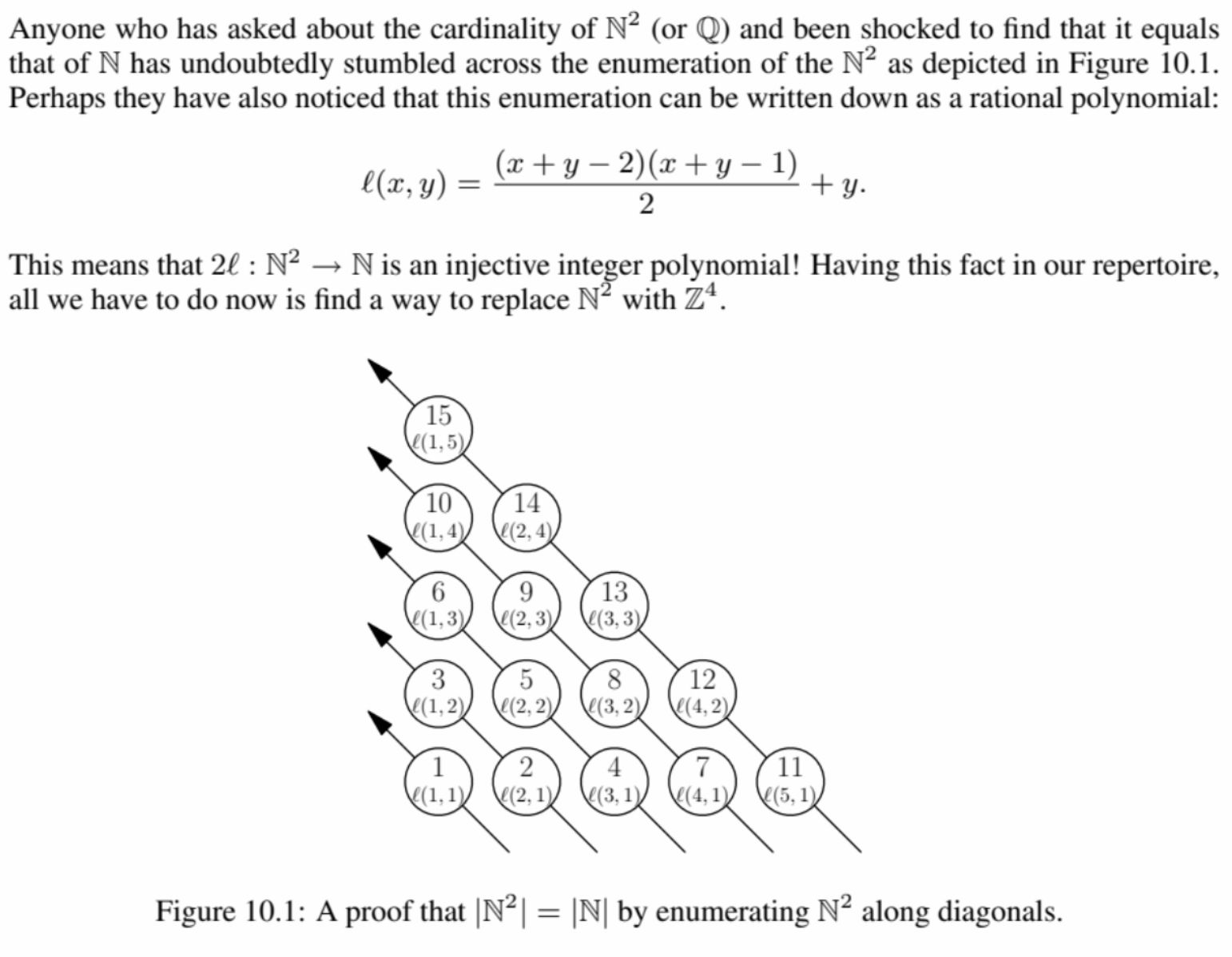
I thought it would be cool to make this into an FE somehow, since the current meta is to make FEs out of anything. Trying a simple f(n)=n-1, I had the following:
(V1) Find all infinite sequence a_1,a_2,\dots of non-negative integers satisfying the following conditions:
- The integer ma_{m+n-1}+(m+n)a_n is even for any positive integers m,n.
- For every positive integer k, there exists a unique ordered pair of positive integers m,n such that k=\frac{ma_{m+n-1}+(m+n)a_n}{2}.
There were two problems with this. Firstly, it looked ugly. Secondly, I could not solve it. There are pathological solutions because you can send terms to 1 whenever you wanted to.
I mulled over this for about a month before deciding to switch to a simpler expression. Separating the terms with m from those with n and finding a suitable function, I got the statement above. Very fortunately, this could be solved because you easily get increasing. I did not intend for that to work, but I think making the expression simpler definitely made it more solvable (and nicer as well).
Let S be a set of positive integers, possibly infinite, such that no positive integer greater than 1 divides all elements of S. Determine all non-periodic infinite sequences a_1,a_2,a_3,\dots of positive integers such that, for all positive integers n,
- a_n\leqslant |a_{n+\ell}-\ell| for all \ell in S, and
- a_n=|a_{n+\ell}-\ell| for at least one \ell in S.
Made in: August 2024
Personal niceness rating: 7/10
Created forwards
The starting point for this proposal is SYMO 2021 Q3 (see the proposer remarks):
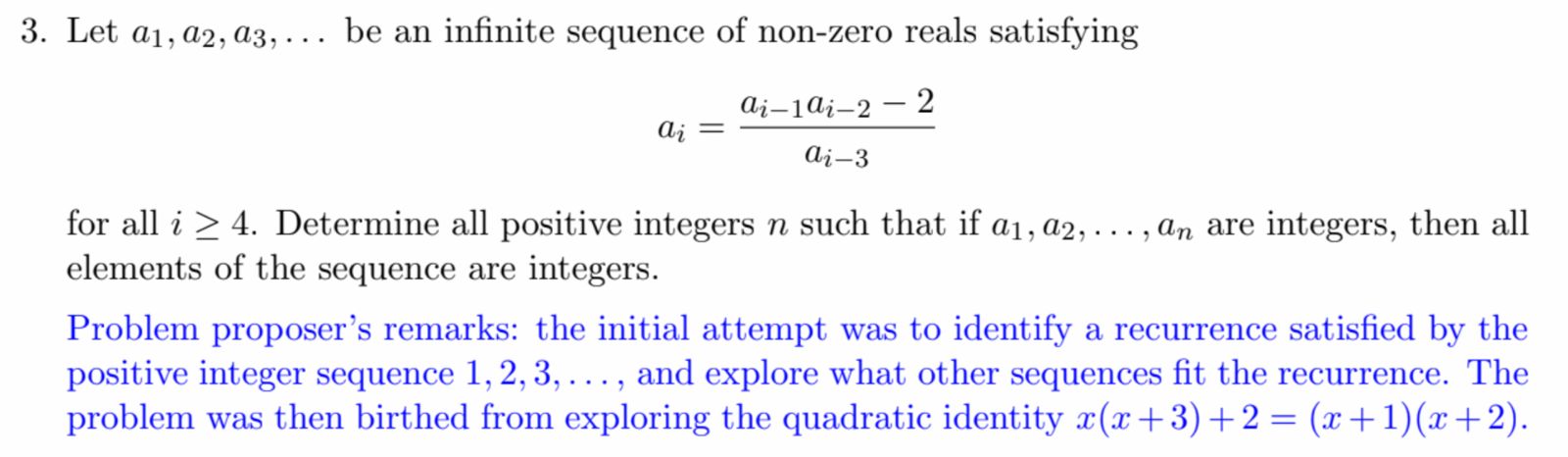
I thought that was cool, so I tried to make a similar sequence. Very quickly, I had a problem statement:
(V1) Consider a sequence a_1,a_2,\dots defined by a_{n+1}=\left\lfloor\frac{a_na_{n-1}}{a_{n-1}-1}\right\rfloorfor n\ge 2. Show that for sufficiently large positive integers n, a_{n+1}=a_n+1.
This was quite boring, so I tried to generalise it:
(V2) Consider a sequence a_1,a_2,\dots defined bya_{n+1}=\left\lfloor\frac{a_n(a_{n-1}+k)}{a_{n-1}}\right\rfloorfor n\ge 2. Show that for sufficiently large positive integers n, a_{n+1}-a_n is constant.
Still, this was relatively trivial by taking out a_n from the floor function. In order to prevent this, I wanted to get the current term to depend on future terms. (I also changed it into FE form.)
(V3) Find all functions f:\mathbb{N}\rightarrow \mathbb{N} such that for any n, f(n+1)=\min \left\lfloor\frac{f(n)f(n+m)}{f(m)}\right\rfloor.
I tried to solve this a while but I realised it was extremely hard (and also not nice). I wanted to focus on the interesting idea of dependence on future terms, which is what makes the sequence/function hard to control. Making it as simple as possible, I got:
(V4) Find all functions f:\mathbb{N}\rightarrow \mathbb{N} such that for any n\in \mathbb{N}, f(n)=\min_{m\in\mathbb{N}} |f(n+m)-m|.
Unfortunately, this went back to being trivial (show f is strictly increasing). Hence, I tried two different adjustments to the problem:
(V5) Let k be a positive integer. Find all functions f:\mathbb{N}\rightarrow \mathbb{N} such that for any n\in \mathbb{N},f(n)=\min_{m\in \mathbb{N}}|f(n+km)-km|.
(V6) Let k be a positive integer. Find all functions f:\mathbb{N}\rightarrow \mathbb{N} such that for any n\in \mathbb{N},f(n)=\min_{m\in \mathbb{N}}|f(n+m)-km|.
After a while, I realised that the correct adjustment to make the problem harder was to change the range of m, and not whatever I was doing. Here is my first attempt:
(V7) Let k be a positive integer. Find all functions f:\mathbb{N}\rightarrow \mathbb{N} such that for any n\in \mathbb{N},f(n)=\min_{m\ge k}|f(n+m)-km|.
How general can we go? What about:
(V8) Let A be a (possibly infinite) set of positive integers. Find all f:\mathbb{N}\rightarrow\mathbb{N} such that for any positive integer n,
f(n)=\min_{m\in A}|f(n+m)-m|.
This turned out to be a mathematically rich structure to analyse. I spent many hours trying to classify the many pathological solutions but eventually gave up, and reluctantly added two conditions to make the question solvable: a gcd condition and non-periodicity.
I submitted the problem as an FE, and the PSC made it a sequence instead. I think the sequence formulation looks more natural but it is much easier to do the algebra in FE form.
An m\times n grid is drawn on a rectangular sheet of paper. Simon cuts along the diagonals of some cells without cutting both diagonals of the same cell. Suppose the paper remains connected, but cutting along any diagonal of any uncut cell would disconnect it. Prove that he made exactly (m-1)\times (n-1) cuts.
Made in: August 2024
Personal niceness rating: 9/10
Created forwards
I wanted to make a problem solved using lasers, so I started drawing random diagonals in a grid. After a while, I discovered this fact. That’s about it actually.
I sent this statement to a friend who helped me prove it.
At some point between then and 2026, I realised that I have seen the statement before on InfinityDots MO:
An n\times n table is written on a square piece of cardboard. Knuffle draws some diagonals in some of the n^2 cells, then uses a knife to cut along the marked diagonals. To Knuffle’s surprise, the resulting piece of cardboard is still connected. Show that at least 2n-1 cells were left uncut.
To my utter surprise, the official solution contained 4 solutions with different graphs, but with no mention that the bound is, in fact, an equality. Nobody on the AoPS thread realised it as well.
I think this is the closest I will ever get to proposing “Russian” combi. This problem has a kinda magical feeling to it that I really like, because there isn’t much reason for the statement to be true at all (of course, if you knew the statement was true, it is relatively easy to prove). Unfortunately, half the problem has appeared before, so my options are limited as to where I can propose it.
Let I be the incenter of \triangle ABC and \omega be its incircle. Let D be the intersection of \omega with BC. Suppose X,Y are points on \omega such that lines IX,IY and AD are tangent to the circumcircle of \triangle AXY. Prove that line XY bisects segment BC.
Made in: December 2024
Personal niceness rating: 8/10
Created backwards
I wrote a post about this one. Parts of it are copied here below:
One day I was looking at a geom solution that involves radius zero circles, and I thought it would be fun to try and construct a problem with the idea.
So what I wanted was a midpoint on a nice collinearity. Why?
If say M is the midpoint of AA' and also lies on line BB', then we can find a circle tangent to AA' at A for which M-B-B' is the radical axis of this circle and the radius zero circle A'. To make the problem work, M has to be a less well-known point so I can conceal it.
With that in mind, I started scrolling through this handout until I saw this config:

In particular, the line N_2 – I – M. This is true because it is the midline of A-D'-X, a classic collinearity.
As discussed above, there exists a circle tangent to AD at A such that IM is the radical axis of this circle and (D). What exactly is this circle? Currently, I only had one condition: that it was tangent to AD at A. So, I needed to find one more point on the circle.

Since I is on the radical axis, the power from I to the circle is ID^2, and so IX,IY are tangent to the circle. (This is the X,Y in the original question.)
This means the two circles are orthogonal. Hence, if I marked the point P where DO intersects the incircle, OA^2=OP\times OD, and hence \angle APD=90^\circ.
But we know many properties of P – for example, it passes through the point diametrically opposite D on the incircle, and also passes through the extouch.
If we look at this classic problem, we are motivated to construct the circle through M with radius MD. So I put all of that in a diagram:

At this point, I had three mutually orthogonal circles. This gave me new ways to define (AXY). For example X,Y,M are collinear and K',K,I are also collinear.
I knew there was a proposal somewhere in this diagram already, and I just had to find what i wanted to ask. There were a lot of possible questions, and I tried to find the one that defines the least number of points.
I forgot exactly what I tried here, but I eventually ended up with the following which I was satisfied with:
Let I be the incenter of \triangle ABC and \omega be its incircle. Let D be the intersection of \omega with BC. Suppose X,Y are points on \omega such that XY bisects BC and AD is tangent to the circumcircle of \triangle AXY. Prove that IX and IY are also tangent to the circumcircle of \triangle AXY.
While lying in bed, I realised that I could combine all the tangencies into one condition and ask to prove XY bisects BC instead, and that’s how I ended up with the actual question. As a bonus, this version had a zero radius circle solution too.
Points B,A,C,D,E lie on a circle in that order such that AB\times CD=AC\times BD \text{ and }AB+CE=AC+BE.Show that the line through E parallel to BC and the line through D perpendicular to AD intersect on the angle bisector of \angle BAC.
Made in: April 2026
Personal niceness rating: 10/10
Created backwards
(For this writeup, I will use the same diagrams I sent to a friend while we were making it, so the diagrams may not look nice.)
One day, we were talking about inequality questions that are actually geometry in disguise. I brought up the following question from Deux SL:
Let a,b,c,d be positive reals such that
a + c = b + d and ab = 3cd. Determine the best constant k such that
k \cdot \frac{ac + bd}{a + b – c – d} \le \sqrt[4]{(a^2 – ab + b^2)(c^2 + cd + d^2)}.
Rather incredibly, the setup to solve this is to introduce a bicentric quadrilateral with lengths a,b,c,d. The relation ab=3cd makes one of the angles 60^\circ by cosine rule on the diagonal, and the rest can be done using some Ptolemy.
That. Is really cool. Let’s generalise.
Consider bicentric quadrilateral ABCD with AB=a,BC=b,CD=c,DA=d. By Pitot, we have a+c=d+b. By cosine rule, d^2+a^2-2ad\cos(\angle A)=b^2+c^2+2bd\cos(\angle A).
Combining the two equations together, we get \frac{bc}{ad}=\frac{1-\cos(\angle A)}{1+\cos(\angle A)}. Classically, this equals \tan^2(\frac{\angle A}{2}). At the same time, we can use (area) sine rule on \frac{bc}{ad}, which is the ratio S_{\triangle ADB}/S_{\triangle CDB}. This equals d(A,DB)/d(C,DB).
While the above seems like a trig bash, it is one of the coolest uses of trig I have seen. Let’s summarise what we have done above.
Starting with a triangle ABC, we can construct a point X such that ABXC is bicentric by finding some point D on BC, extending AD to a point such that AD/DE=\tan^2(\frac{\angle A}{2}), and drawing the line through E parallel to BC. X is then one of the intersections between this line and (ABC).
Constructing a bicentric quadrilateral is not an easy task, so there was something going on in here. Let’s remove the trig by choosing a nice point D. Time for a diagram:
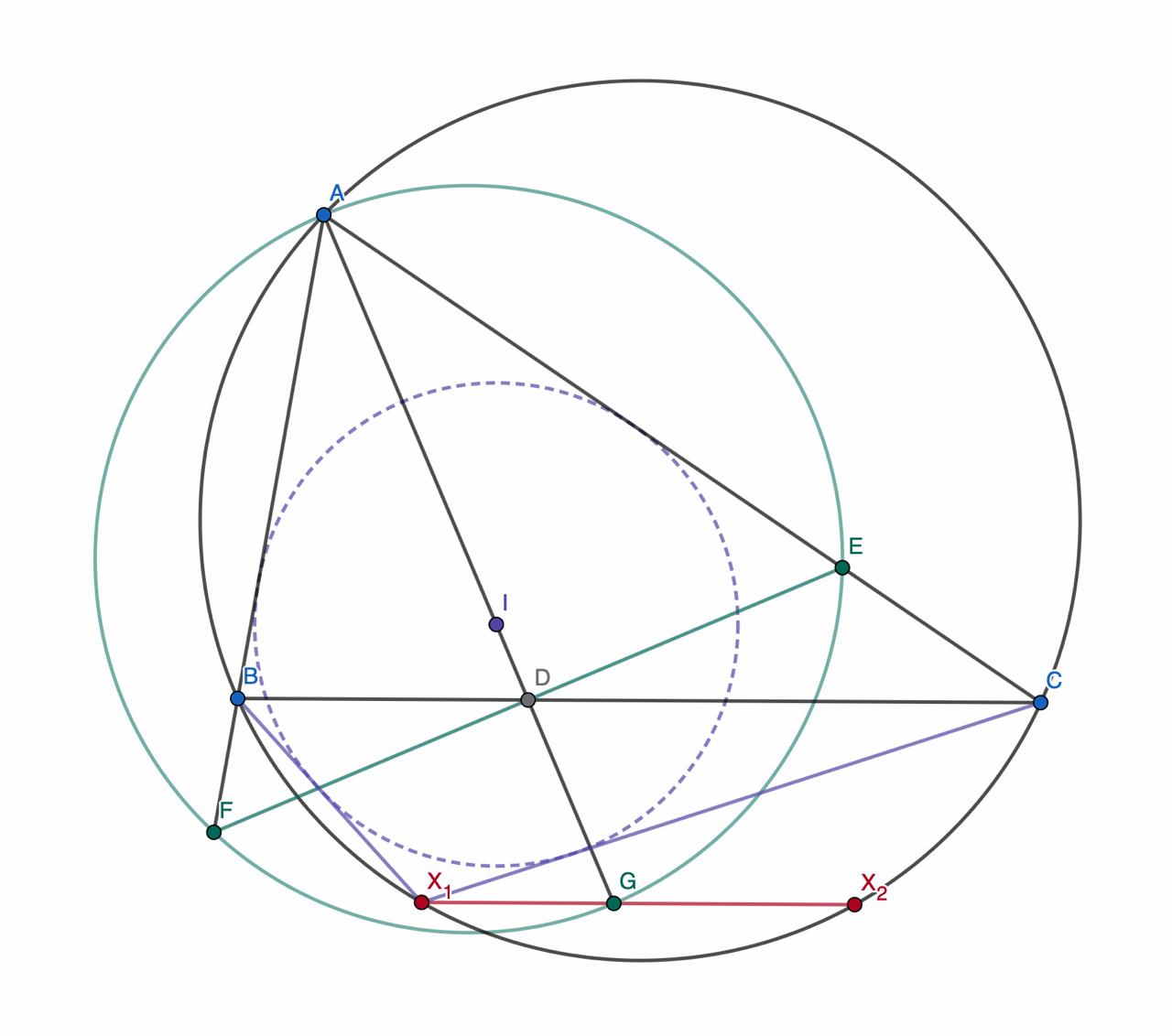
I realised that if D is the foot of the angle bisector, and E,F lie on AB,AC such that DEF\perp AD, then (AEF)\cap AD gives a point with the desired ratio \tan^2(\frac{\angle A}{2}).
I also realised that there were two intersections, X_1,X_2. After a while, I discovered that ABX_2C was an ex-bicentric quadrilateral, which was a cool find.
After this, I played a while with the two circles (the incircle and excircle) to see if I could get any results from there. Here was one of my images from the discussion:
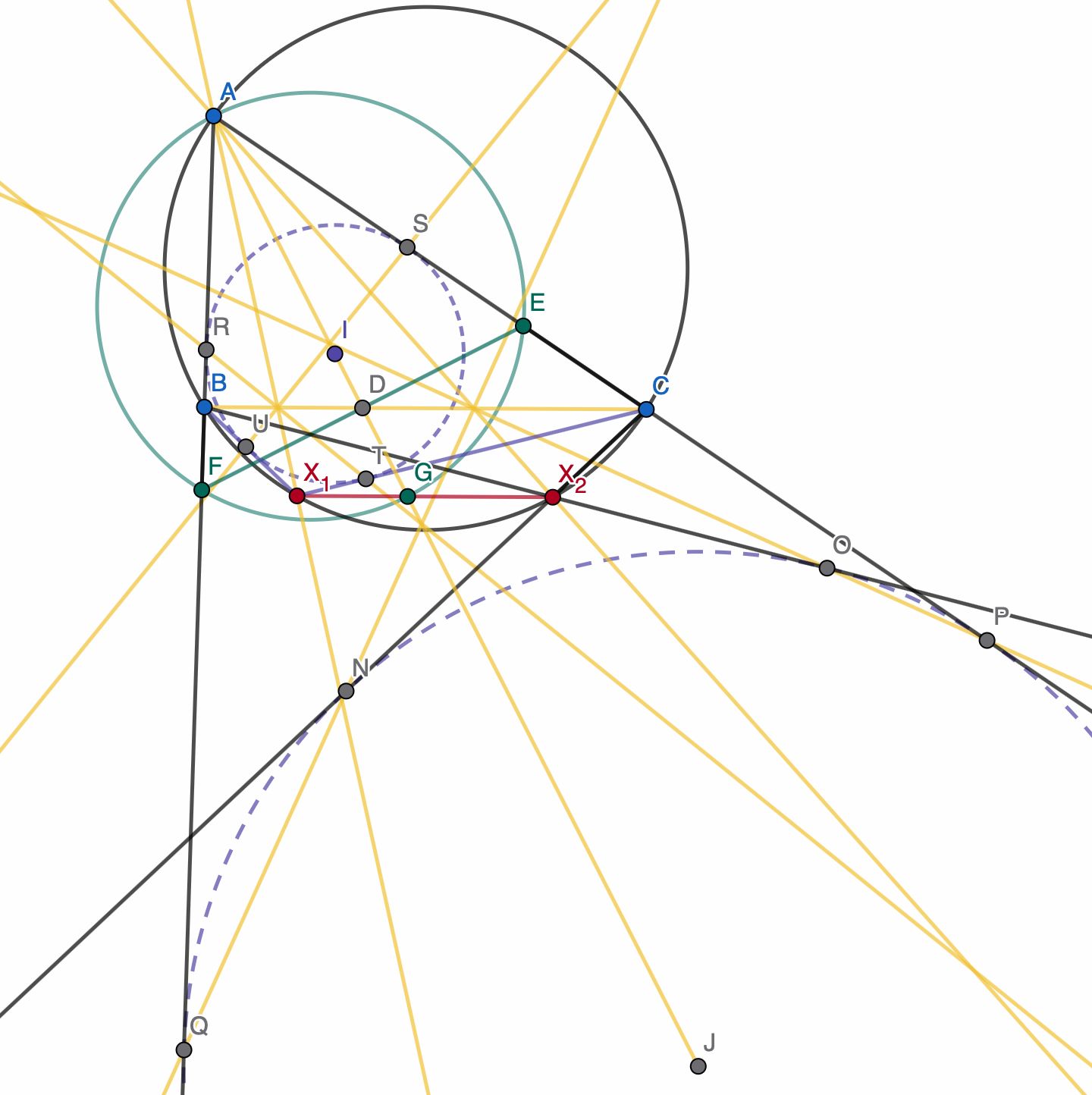
(There are some non-trivial collinearities going on.)
After a while, I realised that if I let (AEF)\cap (ABC) at T, then ABTC is harmonic. This is obvious if you know your configs, but I was a bit rusty. This allows the removal of points E,F, since G can be defined as the intersection of the perpendicular from T to AT and AD.
I sent everything I had back to my friend and he came up with this version of a problem with only 6 points:
(V1) Let ABTC be a cyclic harmonic quadrilateral (AB\le AC). The line through T perpendicular to AT intersects the angle bisector of \angle BAC at G. Let X be a point on the minor arc BT of (ABTC). Prove that ABXC has an incircle if and only if XG\parallel BC.
The rest of it can be summarised in two screenshots:
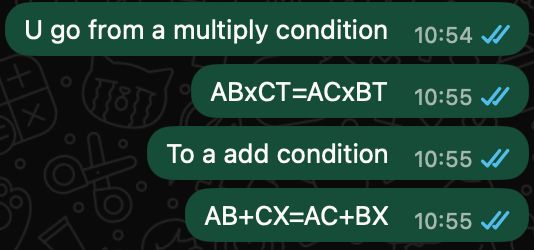
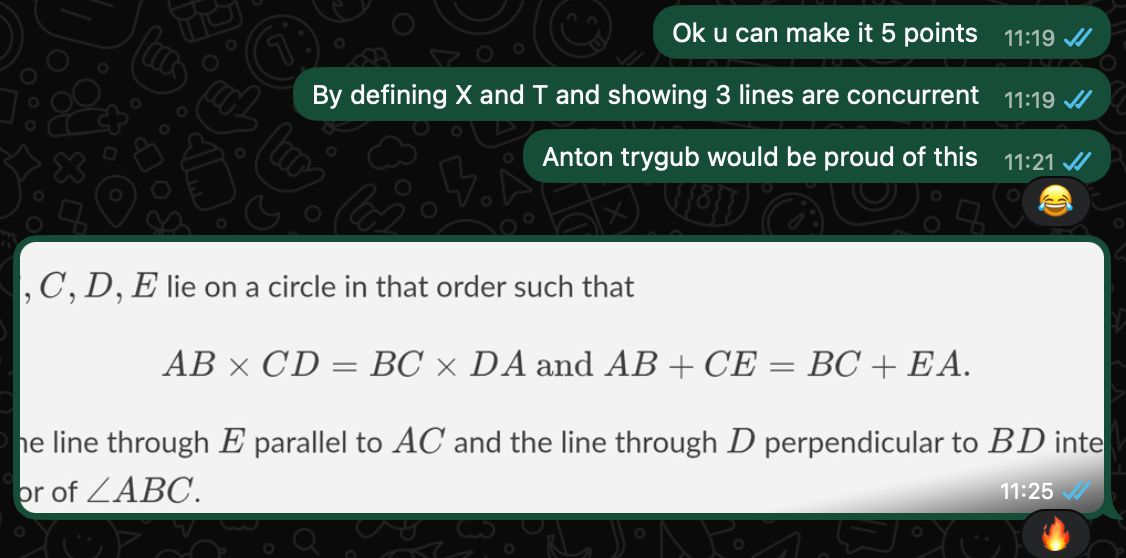
It took me embarrassingly long (measured in weeks) to find a simple synthetic solution to this that didn’t go back through the trig bash route, but I got there eventually. (The solution is beautiful too.)
I love this question. Would engrave the statement on my tombstone.
Points D and E are chosen on segments AB and AC of a triangle \triangle ABC respectively. Let \omega be the circumcircle of \triangle ADE. Let D'\ne D and E'\ne E be points on \omega such that BD'=BD=CE=CE'. The perpendicular bisector of BC intersects \omega at points R and S (S is on the same side of DE as A but R is not). Prove that the perpendicular lines from B to SD' and C to SE' intersect on AR.
Made in: December 2025
Personal niceness rating: 8/10
Created forwards
Some people say that to create geometry problems, just play around on GeoGebra and add random lines and circles until you spot something non-trivial. I have found little success doing this, but this problem is a notable exception.
The base config is BD=CE, which classically implies that the spiral center from DE to BC is the midpoint of the arc BAC.
Besides the spiral, BD=CE is an unwieldy condition. It makes sense to draw in the circles centered at B and C with radius BD=CE. One way to bring the points closer together is to construct D_1 and E_1 such that BDCD_1 and BECE_1 are parallelograms. This gives the following diagram:
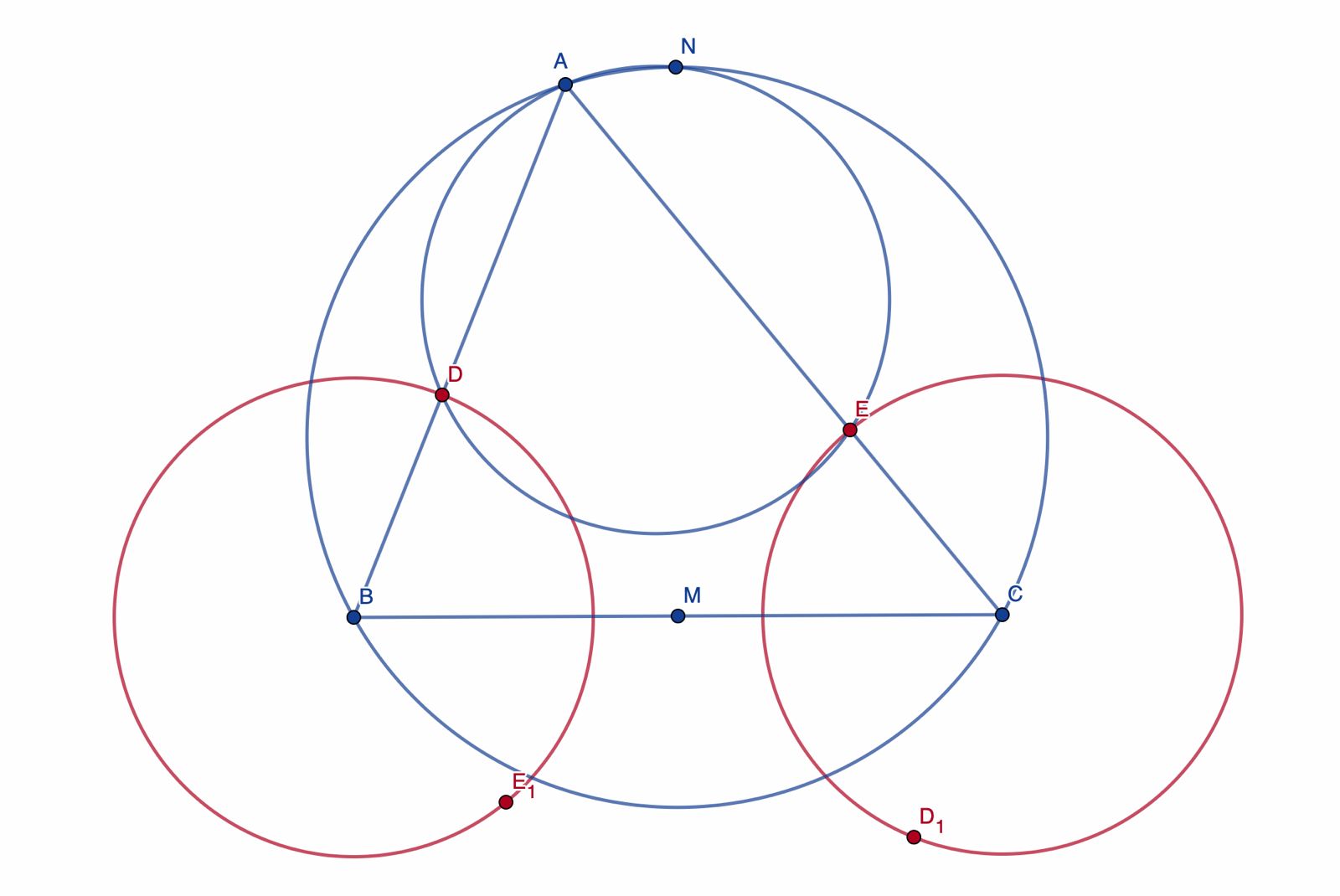
While randomly drawing lines, I realised that ND_1 passes through the second intersection of (ADE) and the red circle (see the green line):
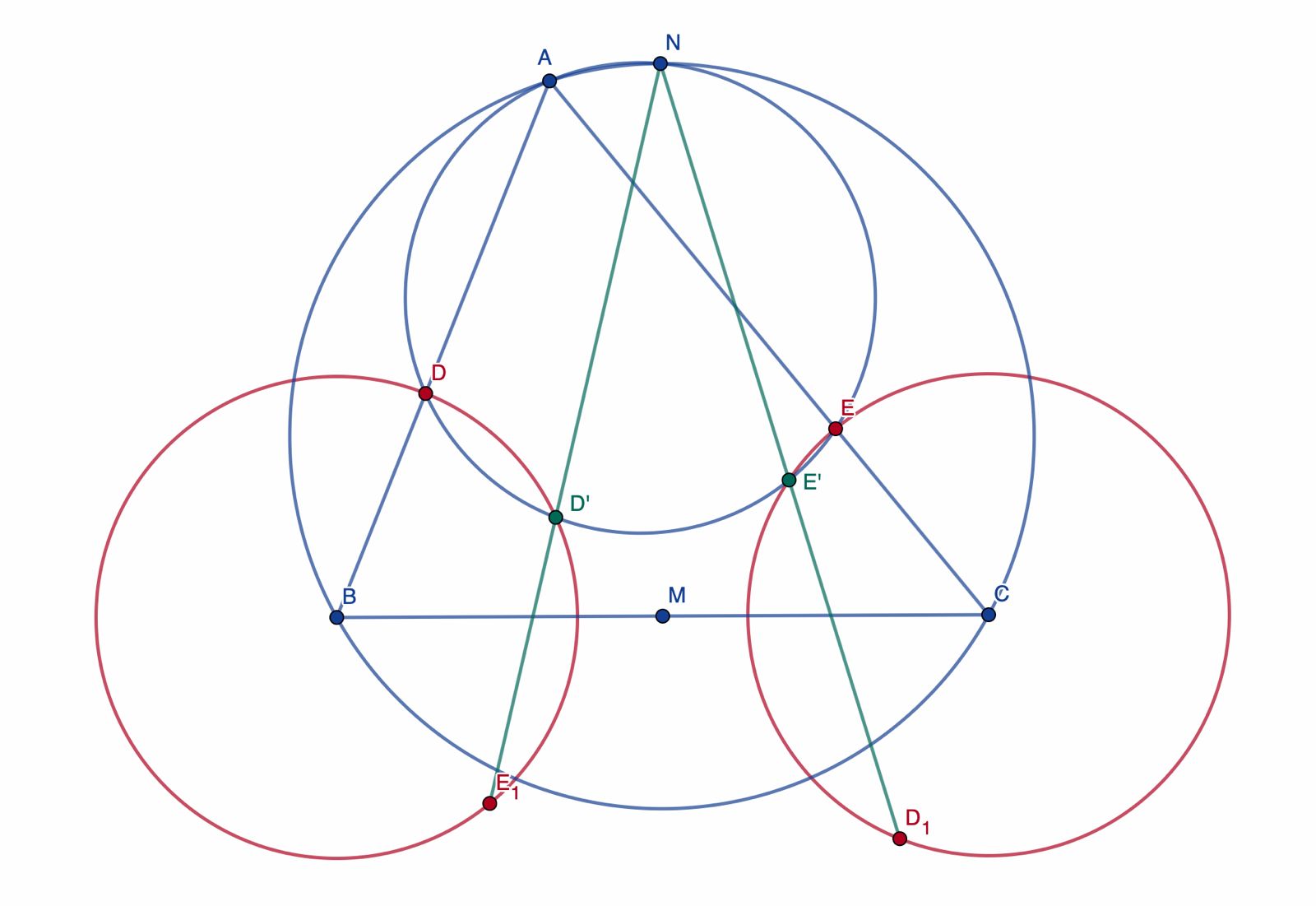
This can be proven with a simple angle chase.
Interestingly, some GeoGebra play revealed that D'E'D_1E_1 is somehow cyclic. We know where the circumcenter O of this circle is — it is the intersection of the perpendiculars from B to NE_1 and from C to ND_1.
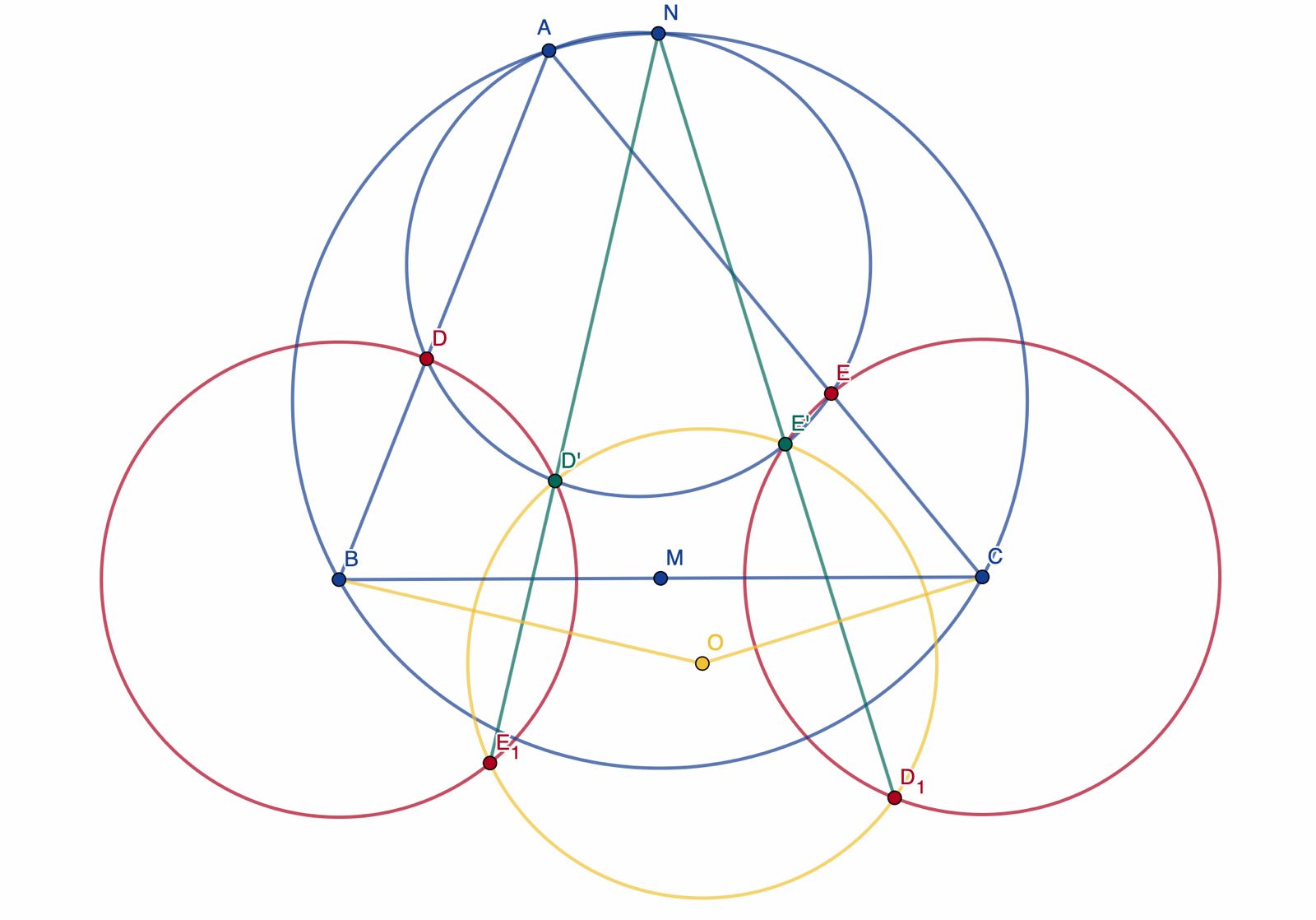
Now here comes the magic: I drew in lines AO and MN and they intersect on (ADE)! I had no idea why that was true, and I spent 2 days trying to find a synthetic solution that I was satisfied with. This is a very difficult problem and it was purely by chance that I discovered this property. (I now have a better idea of why I can expect this concurrency to occur.)
Side note: I know the writeup makes it sound like I drew in all the “correct” constructions, but in truth I probably had 3 times the number of lines/circles on my diagram and maybe tried and deleted 3 times more lines/circles than that. Even so, I do not often find any “coincidences” like the ones in this question.
Let \triangle ABC be an acute triangle with altitudes AD,BE,CF, orthocenter H and circumcircle \Gamma. Let W (\neq A) be the intersection of AH and \Gamma, and T be the intersection of EF and BC. The circumcircle of \triangle TDW meets \Gamma again at X and the circumcircle of \triangle BHC at Y and Z.
Prove that the largest of \angle EWF, \angle EXF, \angle EYF and \angle EZF equals the sum of the other three.
Made in: November 2024
Personal niceness rating: 6/10
Created backwards
One day, I noticed the following: if we take points such that AB^2=AC^2=AD\times AE (A,D,E are collinear), then because of the two pairs of similar triangles, we can angle chase to get \angle BEC+\angle BAC=\angle BDC. In other words, if I define f(X)=\angle BXC, then f(E)+f(A)=f(D).
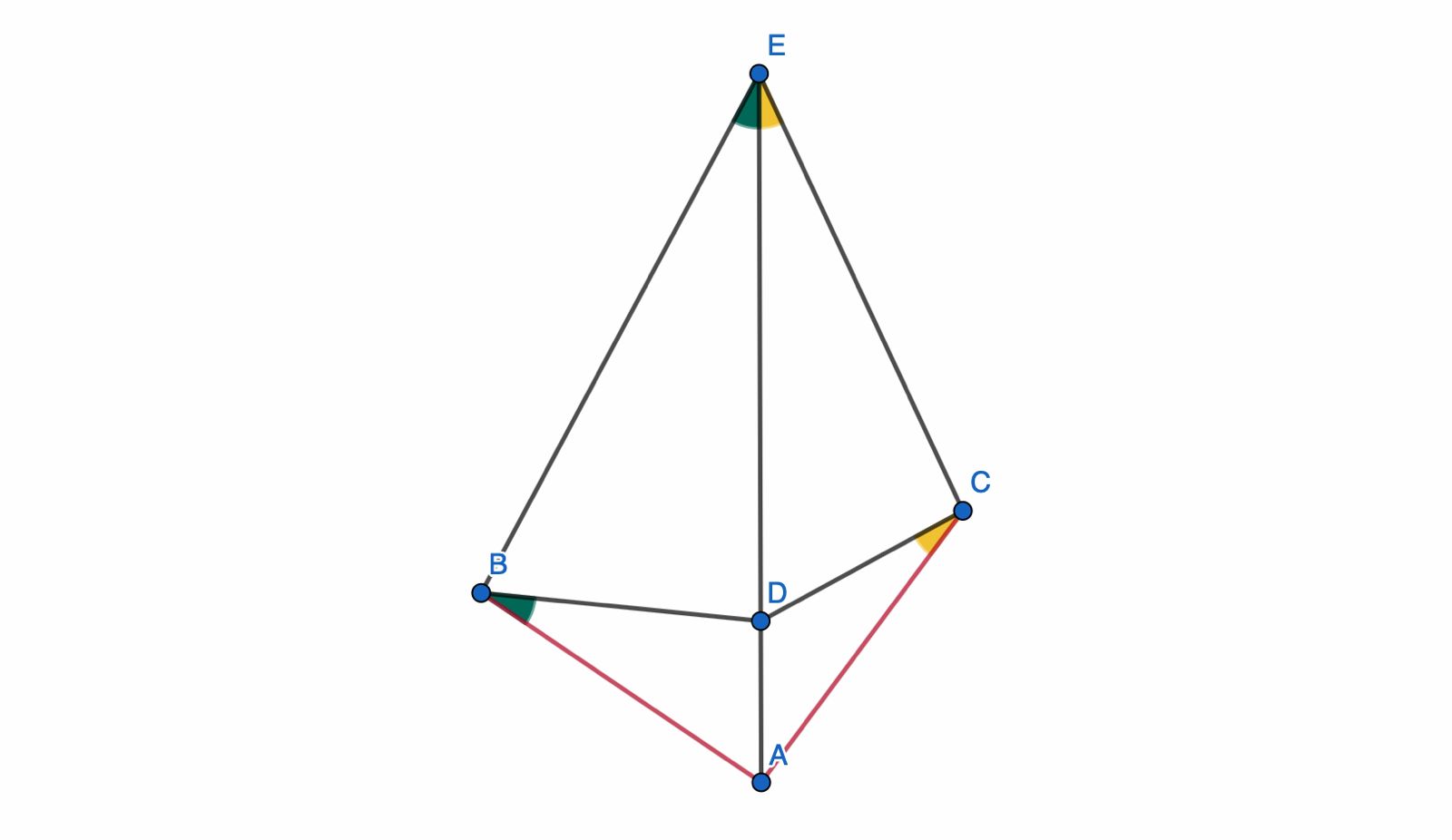
I realised that this fit very well into the orthocenter config, since we get ME^2=MF^2=MB^2=MC^2 where BE,CF are heights. I thus define f(X)=\angle EXF. How do I fit the config above into the diagram? Realising that MB^2 is the power of M to (ABC), I want to draw a line through M which intersects the circumcircle at two points, and then reflect one of these points over M.
Still, there isn’t a proposal in here. The next step is to disguise the config. I thought it would be cool to completely remove the point M by using the config twice to get two equations and removing f(M). I also realised that the reflection of (ABC) across M is conveniently the circle (BHC), so I drew that in.
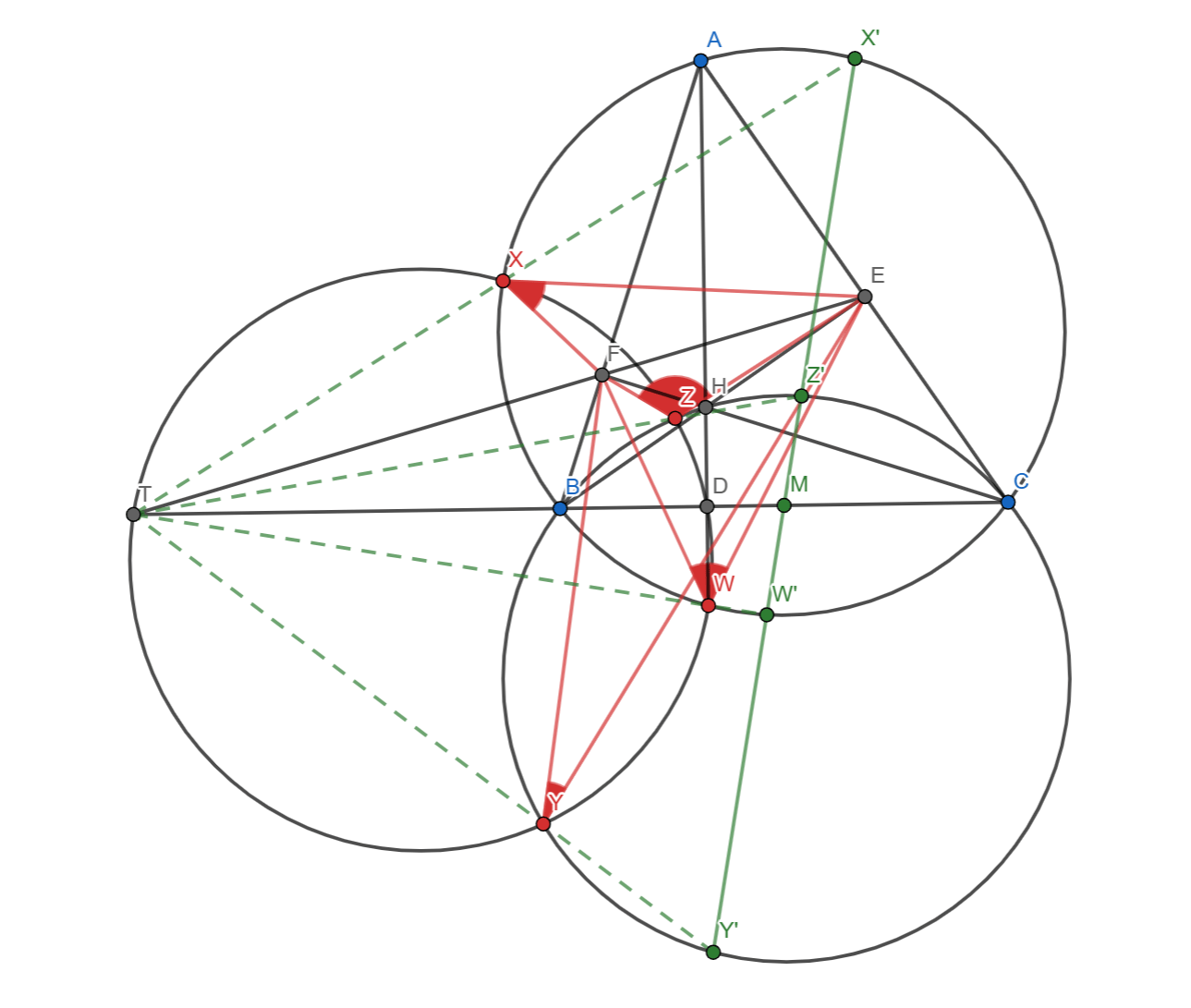
Using the points in the final diagram above, this means that for any line Y'W'MZ'X', I get f(X')+f(M)=f(Z') and f(Y')+f(W')=f(M). Removing f(M), this means f(Z')=f(W')+f(X')+f(Y').
This was interesting, but I did not want to make it any arbitrary line, else it will give away the configuration. I realised I could transfer the angles by doing an inversion at T, which removes the line altogether.
Finally, to disguise the fact that any circle through T and D works, I decided to fix W as well. On hindsight, I’m not sure if this was the correct thing to do.
I figured this problem should never appear on any contest for the sanity of the contestants, so I used it for VT. I am quite happy with the phrasing of the problem, it looks goofy and a bit unhinged.
Let n be a positive integer and \{d_1,d_2,\dots,d_k\} be the set of all positive divisors of n. Prove that for any positive integer m for which \gcd(m,k)=1, d_1+d_2+\dots+d_k\mid d_1^m+d_2^m+\dots+d_k^m.
Made in: September 2024
Personal niceness rating: 7/10
Created backwards
The starting point for this proposal is this problem from Iran MO 2024:
For a given positive integer number n find all subsets \{r_0,r_1,\cdots,r_n\}\subset \mathbb{N} such that
n^n+n^{n-1}+\cdots+1 \mid n^{r_n}+\cdots+ n^{r_0}.
For this question, the key is to realise that you can replace r_i with r_i\pmod{n+1}, as n^{n+1}-1 is a multiple of the LHS. Hence, if your r_is are a CRS modulo n+1, the divisibility holds.
What happens if we force r_i=i\cdot k? Then, the statement holds when \gcd(k,n+1)=1. This gives an interesting fact: \gcd(k,n+1)=1 implies \frac{m^{n+1}-1}{m-1}\text{ is divisible by } \frac{m^{k(n+1)}-1}{m^k-1}.This is reminiscent of the sum of divisor formula.
In fact, taking m as primes and multiplying these divisibilities together, we get the original statement. The individual gcd conditions nicely multiply together as well.
At this point, the problem is still pretty trivial. I tried two ways to make it harder.
First, the divisibility and the gcd condition is not if and only if. There are exceptions where the divisibility can hold and the gcd is not 1. I tried to study these exceptions but they were very hard to control (because primes).
Second, I tried to make it into an analytic question. For example, what is the smallest k that makes the divisibility true? This is upper bounded by the smallest k satisfying \gcd(m,k)=1, which is around \ln(m)=\ln(d(n)). While this is definitely harder as it hides the gcd condition, it also looks ugly.
Hence, when we were finding easy Q1s for CWMIST, I submitted the original version of the question. I firmly believe it is way harder to make good easy questions than good hard questions. Put another way, it is trivial to make easy and trivial problems but non-trivial to make easy and non-trivial problems.
Consider a polynomial P(x) with integer coefficients. For any positive integer n, define f(n) to be the number of coefficients in P(x)^n that are not multiples of 67. Show that for all sufficiently large n, at least n^{0.99} of the numbers f(1),f(2),\dots,f(n) are perfect 2026th powers.
Made in: February 2026
Personal niceness rating: 9/10
Created backwards
I was scrolling through the IMO Longlist for reasons I cannot remember, and I stumbled upon the following problem from the 1988 ILL:
Let n be a positive integer. Find the number of odd coefficients of the polynomialu_n(x) = (x^2 + x + 1)^n.
The solution uses the fact that (x^2+x+1)^{2^k}\equiv x^{2^{k+1}}+x^{2^k}+1\pmod{2}by Fermat Little Theorem. Hence, we can write n in binary and expand it (similar to fast exponentiation algorithm).
I tried to do this for arbitrary primes and polynomials. If we let p be a prime and k=a_tp^t+a_{t-1}p^{t-1}+\dots+a_1p+a_0 (base p representation), then P(x)^k\equiv \prod_{i=0}^tP(x)^{a_ip^i}\equiv \prod_{i=0}^tP\left(x^{p^i}\right)^{a_i}\pmod{p}.It is not very easy to simplify this further, because when you fully the expand the RHS, some terms have the same degree. But what if I force them to not do that?
The easiest way to make a_i small compared to p. How small before no two terms in the expansion have the same degree? We need a_i\le\frac{p}{deg(P)}.
At this point, I already had a problem somewhere, I just needed to figure out how to ask it. Firstly, what do I do after the products do not interact? The simplest way is to talk about perfect squares, since each digit just needs to be even.
After that, my priority was to hide the key fact (importance of size of a_i). I thought the best way to do it is to count the number of such k (such that all base p digits is \le\frac{p}{deg(P)}). To my slight surprise, there were many such numbers, larger than any \mathcal{O}(n^{1-\varepsilon}), as long as n and p are large enough.
I sent this to a friend to testsolve, and he found out that if p is too small, the same argument can be done with a sufficiently large power of p. After a bit of cosmetic adjustment, this leads to the final problem statement. My intention is that a solver who first looks at the problem will think “wow that’s a lot of 2026th powers”.